No products in the cart.
Publication Date: 16.07.2024
Scented Oils of Lydia
Cosmetics of Lydia[i] were famous during the heyday of Lydian power and were remembered for centuries thereafter. The form of the cosmetics is unclear from the texts, but the design of the containers shows that they were meant for liquid and viscous or granular to powdery contents. Aroma was a feature, but whether a primary or secondary aspect remains to be determined. Bakkaris and brenthon or brentheion myron are Lydian cosmetics that are cited in Greek and Roman literature. Bakkaris is the more fully documented; and is cited by Greek writers of the middle of the seventh through fifth centuries BC; the earliest of whom, Ionian poets Semonides of Amorgos and Hipponax of Ephesus, hailed from places close to Lydia and were contemporaries of the last Lydian kings; Hipponax also was familiar with Lydian language and culture.
Bakkaris had a pleasant scent and might be applied to the nose; it was associated with unguents (mura, typically wet and commonly liquid) but was separately named by writers who associated the two, as if in recognition of a difference, and verbs of application used by writers of the seventh–fifth centuries BC whose testimony is quoted leave unclear whether the form of bakkaris was liquid, viscous, or dry. That bakkaris was an unguent, however, and also a plant, and that the root of the plant was used to make unguents was credited to Aristophanes by two writers of the first century AD, polymath Pliny the Elder and physician Erotian (although bakkaris and unguents are separately cited in a surviving fragment of Aristophanes). Their contemporary, the physician Dioscorides, wrote in his celebrated pharmacological treatise that uses of the plant bakkaris included using its root “in scented oils and powders to sprinkle over the body since it is quite aromatic.”
Bakkaris was explicitly described by Dioscorides, and a manuscript of his treatise, dated to the last quarter of the ninth or early tenth century AD, contains an illustration.

The plant Bakkaris in a 9th C. AD illustrated manuscript of Dioscurides, De Materia Medica; New York, the Pierpont Morgan Library

The plant Bakkaris, detail
The tombs of Lydia are perhaps its most conspicuous legacy. Burial mounds dominate the landscape of Sardis and give visual testimony to ancient settlement throughout Lydia. The most prevalent vessel shapes among Lydian grave offerings are small containers for oil perfumed: lekythoi, askoi, and alabastron were made for liquid contents scented oils; especially bakkaris, myrtle, rose, cinnamon and marjoram. Why these were so important as grave offerings is not entirely clear. They may be viewed as further items related to personal grooming, as symbols of the pleasures of life, or (if their contents were expensive) as indications of wealth. Alternatively, they may have been included as elements of banqueting assemblages, since fragrance oils as well as incense could be used to create an atmosphere of luxury at banquets. [ii]
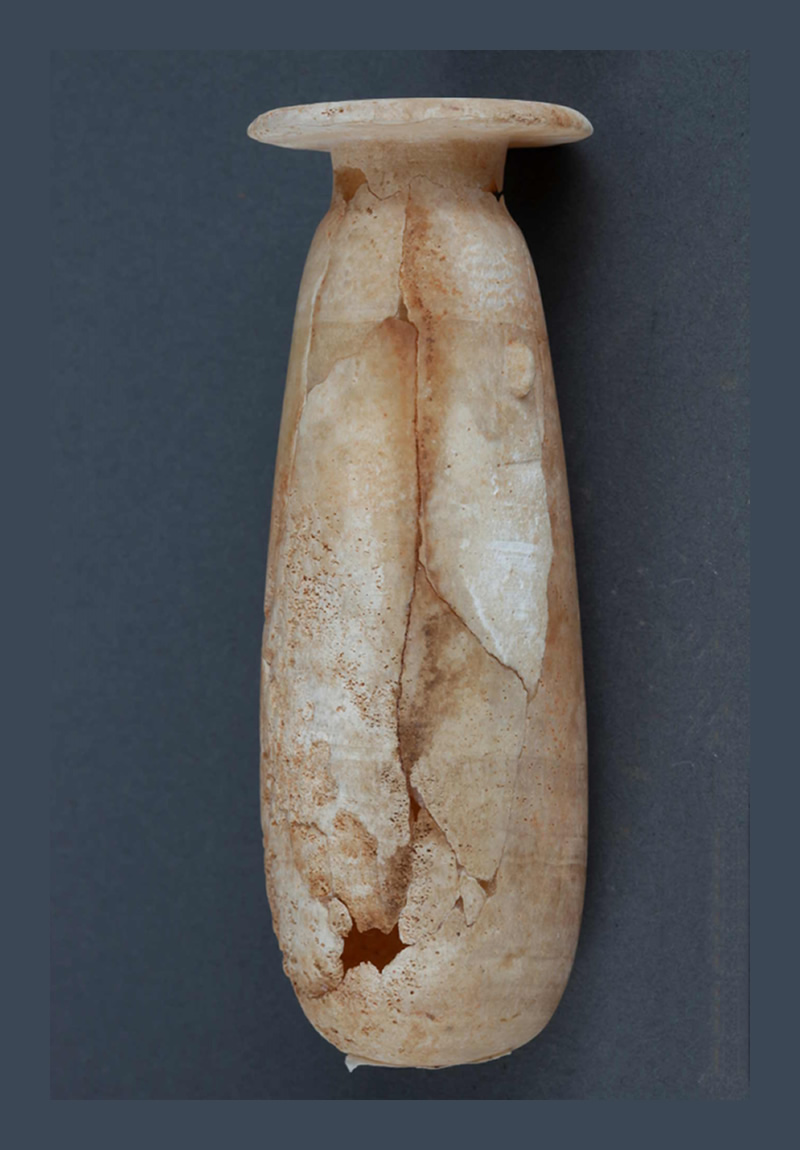
Alabaster alabastron. As a container for perfumed oils.
Vedat Nedim Tör Museum, Istanbul
Compiled by Halil ÖZER
* * * * * * * * * * * * * * * * * *
[i] Lydian Cosmetics, Crawford H. Greenewalt, jr. (2010) The Lydians and their World, Yapı Kredi Yayınları
[ii] Lydian Burail Customs, Baughan E. (2010) The Lydians and their World, Yapı Kredi Yayınları