No products in the cart.
Publication Date: 14.05.2025
The Ancient Perfume Stores
THE ORIGINS OF THE FIRST PERFUMES
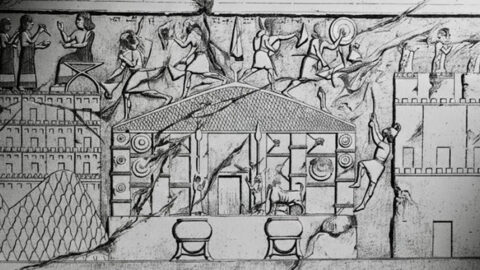
The first containers of fragrant substances were discovered in Sumerian and date back to the fourth millennium BCE. We might conclude from this that perfume was invented in the East, and written evidence and objects have been found which indicate that it was prominent in the day-to-day lives of ancient civilizations. It is thought that from Sumerian perfume infiltrated Mesopotamia (most of which is now present-dayAnatolia) and then headed north to the Levant coast, or was shipped to the Persian Gulf and then across the Indian Ocean, from the first millennium BCE onwards. By the Bronze Age, perfume could be found in the eastern Mediterranean, Levant, Egypt and in and around Mesopotamia. Scented substances mainly resins were used in censers and perfume burners during fumigation rituals. They were considered to be rare and bear a divine imprint, so were reserved for the gods, while perfume had associations with power. Because it elevated humans and linked them to an immutable, superior order, and because fumigation was also part of funeral rituals, perfume had cult status in all the ancient religions.

Incense burner
Upper Mesopotamian region
1300 A.D.
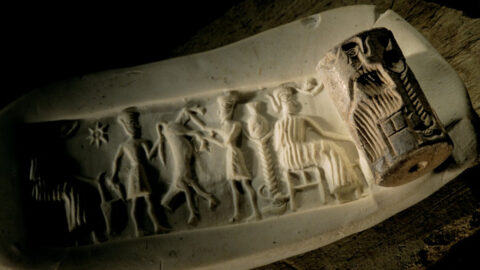
There is documentary evidence from Mesopotamia showing that perfume made an appearance in the middle of the third millennium BCE, always in the form of scented oil. It was used by kings and the elite for personal grooming, and by priests during religious ceremonies. The perfume burners and censers found in temples and palaces tell us that substances were burned to tantalize the gods and purify the air, thereby eradicating bad smells and the emanations of evil spirits.

Woman holding the aryballos (A flak used to store scented oil)
Period: Neo-Sumerian / Mesopotamia
Middle of the third millennium B.C.
ALL KIND OF PERFUMED OILS
In Ur, at the end of the third millennium BCE, the doors, floors and floor coverings of the temples were perfumed with cedar oil. During the Bronze Age (3000-1000 BCE), perfumed oil entered secular society. It was used for personal grooming and adornment and became a sign of social standing. This status symbol was taken to the grave, as demonstrated by the bottles found in burial sites. According to documents from ancient Mesopotamia that the first perfumes took the form of scented oils. The many variations available included primarily chufa, linseed, lettuce seed, sesame and ben oils scented with herbs, spices and flowers such as marjoram, white violet, blue lotus, narcissus, iris and rose.

Ancient Document 987 – 990 A.D.
PERFUME IN ROMAN TIMES
The Roman Empire placed the greatest importance of all on cosmetics and perfume. Although perfume was little used in ancient Rome, the Romans gained a better knowledge of the art of perfumery when they came into contact with the Etruscans and Phoenicians. It was one of the main substances they brought back from their conquests. Roman colonization and the resulting trade introduced spices, incense, perfume baths and the use of saffron for personal grooming to what is now the Italian peninsula. The Romans maintained the Egyptian, Greek and Oriental trade networks that brought scented products in their raw state from Arabia, Africa and India. Perfume production was commonplace in Rome and indeed the peninsula as a whole. We know that in Campania it reached almost industrial proportions, primarily due to the production of olive and almond oils and the vast range of flowers, roses in particular, that grew there. The Romans believed that many aromatic substances had medicinal qualities and their use of perfume for non-religious purposes, particularly at their many banquets and in their thermal baths, was almost excessive.

Roman blown and mould blown glass cosmetics flasks
Period: Roman
1st century A.D.
THE ANCIENT PERFUME STORES
Colonnaded avenues, which have an important place in the urban planning of Roman architecture, appear as a characteristic feature of the urban planning of Rome, especially in the Eastern Provinces. In addition to Anatolia, the Roman settlements of Northern Syria and Northern Africa have survived to the present day with their remains, and the most beautiful examples of these streets are found not in central Rome, but in the eastern provinces of Rome, especially in the provinces of Asia, Lycia and Cilicia.
Colonnaded avenues, with their monumental architecture and the sculptures within this architecture, have become symbols showing the power and might of the Roman Empire, which used the architectural repertoire as a propaganda tool. Such monumental structures also show a line that coincides with the philosophy of Roman society, which was fond of ostentation and splendour. Behind the aforementioned porticoes, the doors arranged at certain intervals form the entrances to the shops, where both production and sales can be made. It is understood that in the regions of the Mediterranean basin, where winters are generally mild and rainy and summers are hot, street designs that allow people to stroll comfortably under columned porticoes sheltered from rain and sun and to shop in the shops behind these porticoes have emerged in accordance with the climate in question.
Most of these shops were accessible by multiple doorways and had marble or tile floors. Staircases or wooden ladders gave access to an upper level, which provided storage space and living quarters that overlooked the bustling portico and noisy street. Along this avenues there were shops and glass workshops, ceramic workshops, fabric shops, restaurants and stores called Unguentarii. Perfumes, creams, oils and various cosmetics are sold in the Unguentarii. These products were presented to customers in glass or ceramic containers called Unguentarium.

Glass Unguentarium; vials containing perfumes, balms and ointments.
Period: Ancient Roman
2ND / 4TH century A.D.
Written by Halil ÖZER